

From Betting Model to 1 Million Downloads: How iTero Is Shaping the Future of AI Coaching in Esports

AI-powered League of Legends coaching app iTero has surpassed one million downloads, marking a major milestone for a product that began not as a consumer gaming tool, but as an esports betting model.
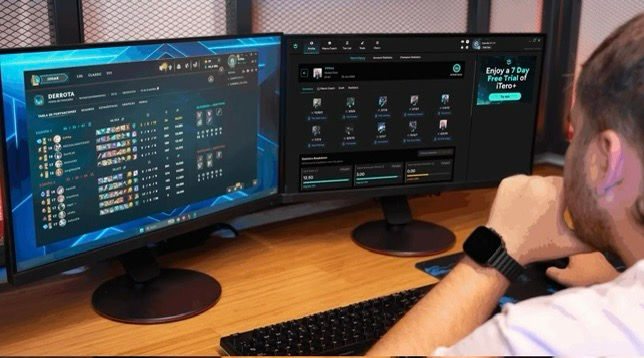
Founded by Jack Williams and acquired by GIANTX, formerly XL Esports, in 2024, iTero has evolved from a professional-team analytics concept into an AI companion designed to help everyday League players improve their decision-making and climb the ranked ladder.
Williams has a Master’s degree in artificial intelligence and previously worked in data science and AI-related roles at HSBC and Deloitte. During the COVID period, he began analysing esports betting markets after noticing what he believed was an inefficiency in League of Legends odds.
Specifically, Williams observed that betting prices were not always adjusting sufficiently after the draft had been locked in, despite champion selection, early picks and counter-picks having a meaningful influence on a team’s chances of winning.
He therefore built AI models capable of analysing the game state at the end of the draft and predicting the likely winner. Williams said the system became profitable enough that his betting accounts were eventually restricted after he consistently won.
With the model no longer useful for betting, he began exploring whether the technology could help professional esports teams instead.
Williams contacted Excel Esports co-founder Kieran Holmes-Derby and demonstrated his system at the organization’s former base inside Twickenham Stadium. The experience convinced him there was an opportunity to build technology that could help teams draft more effectively and ultimately win more games.
He subsequently left Deloitte and committed himself full-time to developing the product.
The initial business-to-business strategy, however, failed. Williams spent roughly six months building the system and another three months attempting to sell it to professional teams — without securing a single contract.
One major obstacle was timing. AI had not yet become a mainstream technology trend, while many esports organizations still operated relatively basic analytics departments. Convincing coaches and players to trust recommendations from a sophisticated “black-box” AI model proved extremely difficult.
The turning point came through Overwolf. After Williams gained attention through an Esports Insider pitch competition, he was encouraged to stop focusing exclusively on professional teams and instead develop the technology for ordinary players.
Within three months, iTero launched its first consumer product.
Williams admits the early version looked poor, but players valued its functionality. Downloads quickly climbed from zero to 10,000, while retention rates were considerably stronger than those typically seen among similar gaming applications.
Overwolf subsequently provided Williams with a non-dilutive grant, allowing him to hire a developer without giving up equity.
Over the following two years, iTero developed into a more complete AI companion capable of helping League players improve their drafting and decision-making while working toward their next competitive rank. Downloads eventually reached between 100,000 and 200,000.
Then came the 2024 acquisition by GIANTX, bringing Williams back into the same esports ecosystem where his original idea had first been demonstrated.
Following the acquisition, iTero shifted its focus heavily toward growth and product development. Williams believes there is a natural synergy between an esports organization trying to win the LEC and an AI product helping an ordinary solo-queue player win their next ranked game.
Integration with GIANTX also gives iTero direct access to professional players and coaches. Their high-level game knowledge can help improve the AI models, while the esports organization itself provides a powerful platform for marketing the product.
The result has been rapid expansion, culminating in iTero reaching the one-million-download milestone.
Its journey also illustrates how quickly AI’s role in esports is evolving. What began as a model designed to exploit inefficient betting odds has become technology capable of assisting with drafting, player development, scouting and competitive decision-making.
The next question may be more complicated: as AI coaching becomes increasingly sophisticated, where should esports draw the line between legitimate training assistance and real-time AI-assisted cheating?
For iTero, GIANTX and the wider esports industry, answering that question could become just as important as developing the technology itself.


Comments